In 2026, the global cinematic landscape is being reshaped by a convergence of scale, ambition, and evolving audience preferences. Bollywood is rapidly narrowing the production value gap with Hollywood, while Hollywood continues to leverage its long-standing dominance through franchise-driven storytelling. At the same time, the Indian box office is witnessing strong momentum, with projected growth of 25–30% over 2025, driven by a combination of big-budget Hindi films, thriving regional cinema, and major international releases.
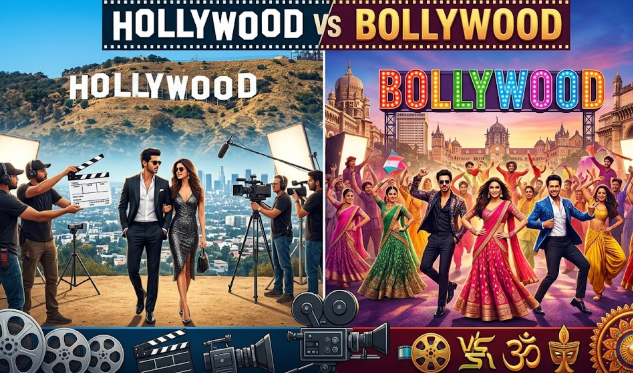
Production Scale and Budget Expansion
One of the most defining shifts in 2026 is Bollywood’s move toward large-scale, high-budget filmmaking. The industry is transitioning beyond the traditional “₹100 crore club” to embrace productions in the ₹500–₹1000 crore range. Films such as Ramayana and Toxic are setting new benchmarks, combining advanced visual effects, global talent, and multi-language releases to compete with Hollywood’s spectacle-driven model.
Hollywood, meanwhile, continues to dominate the high-budget space through its established franchise ecosystem. Projects like Dune: Part Three and Avengers: Doomsday exemplify its focus on event cinema designed to drive massive theatrical turnout. However, this heavy reliance on franchises also reflects a more cautious, risk-averse strategy compared to Bollywood’s current phase of expansion and experimentation.
Evolving Narratives and Content Strategy
Bollywood is undergoing a notable transformation in storytelling. While the star system—featuring actors like Salman Khan, Shah Rukh Khan, and Ranbir Kapoor—remains influential, there is a growing shift toward “pan-India” narratives with global appeal. These stories increasingly blend cultural depth with large-scale action and more complex, layered themes.
Hollywood, on the other hand, is navigating a dual ecosystem of theatrical releases and streaming platforms. Content is often shaped by data-driven insights, resulting in genre-blending narratives designed to maximize engagement across both cinema screens and OTT platforms. This has led to a more structured and sometimes formulaic approach to storytelling.
Global Reach and the Rise of Streaming
Streaming platforms have become a major growth engine for both industries. Services like Netflix and Amazon Prime Video are expanding the global reach of content, enabling films to transcend geographical boundaries.
Bollywood is no longer confined to the Indian diaspora. Regional industries—particularly Telugu, Tamil, and Malayalam cinema—are gaining international recognition, contributing significantly to India’s global content footprint. While Hollywood still benefits from a more established global distribution network, the gap is steadily narrowing as Indian films adopt aggressive international marketing strategies and multilingual releases.
Box Office Dynamics and Competition
The Indian box office in 2026 is characterized by intense competition and diversity. High-profile clashes between Bollywood releases like King and Dhurandhar 2 and Hollywood blockbusters such as Dune: Part Three and Avengers: Doomsday highlight the increasingly competitive environment.
Regional cinema continues to play a pivotal role, particularly South Indian films, which are challenging traditional Hindi cinema dominance. The rise of the “pan-India” model—where films are designed for nationwide and global audiences from inception—is redefining box office dynamics.
Technology and Innovation
Hollywood maintains its leadership in technological sophistication, particularly in CGI, motion capture, and large-scale production infrastructure. However, innovation is often tempered by regulatory frameworks and high production costs.
In contrast, Bollywood and the broader Indian film industry are adopting new technologies at a faster pace. AI-assisted editing, advanced dubbing techniques, and cost-efficient production methods are enabling faster turnaround times while maintaining high production values. This agility is becoming a key competitive advantage.
Industry Growth and Market Momentum
While Hollywood remains the global leader in revenue and influence, its growth trajectory is stabilizing. The Indian film industry, however, is experiencing rapid expansion. The combined impact of theatrical releases, OTT growth, and international collaborations is accelerating its global presence.
A significant shift from purely star-driven cinema to a “content + scale” approach is driving Bollywood’s rise, allowing it to compete more effectively on both creative and commercial fronts.
Conclusion
In 2026, Hollywood and Bollywood are no longer operating in isolation. Instead, they are converging in ambition while differing in execution. Hollywood continues to rely on franchise strength, technological excellence, and global distribution, whereas Bollywood is scaling aggressively through bold investments, culturally rooted storytelling, and expanding international reach.
This evolving dynamic is creating a more competitive and interconnected global film industry one where the future of cinema will likely be shaped by a fusion of spectacle and storytelling, and by the balance between global appeal and cultural authenticity.
