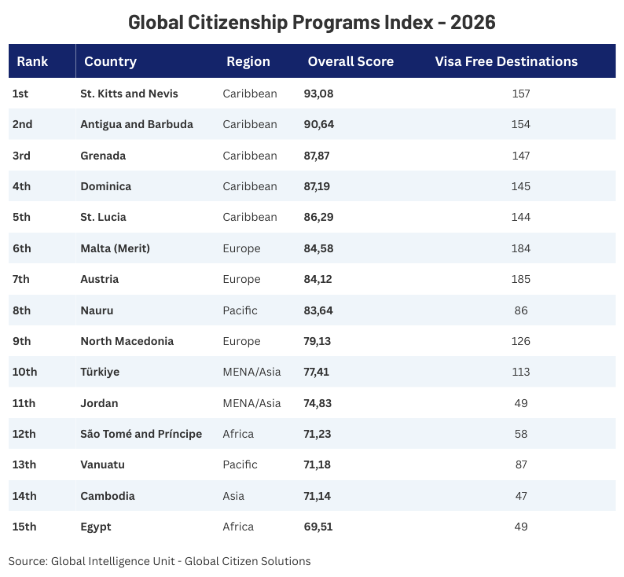
London – May 27, 2026 — Global Citizen Solutions (GCS), a leading citizenship and residency advisory firm, today releases the Global Citizenship Programs Index 2026 (GCP Index 2026) — an independent, data-driven assessment of active sovereign Citizenship Programs worldwide. The 2026 edition evaluates fifteen schemes across five continents through eighteen performance indicators grouped in five thematic sub-indexes: Procedure, Mobility, Tax Optimization, Quality of Life, Investment, and two cross-cutting indicators: Compliance and Credibility.
Published over forty years after the Saint Kitts and Nevis Act of 1984 created the world’s first investment migration program, the GCP Index 2026 arrives at a moment of genuine structural change. The 2026 edition spanning five continents — from the Eastern Caribbean to Europe, the Pacific, MENA, and an emerging African presence — reflects an industry that has grown far beyond its island origins. The overarching finding is that the market is consolidating governance quality rather than price, with compliance, not cost, now the primary axis of competition across all regions.
“The most important shift in our industry is no longer about which single program is best suited to your needs, but about which combination of programs is the right one,” said Patricia Casaburi, CEO, Global Citizen Solutions. “Families today are constructing citizenship portfolios of mobility, tax residence, and legal access that reflect a far more sophisticated understanding of risk, opportunity, and belonging in a fragmented world. The 2026 GCPI reflects that reality. It assesses each program on its own merits, but it is designed to be read as a map: showing where each jurisdiction excels, where it falls short, and how it fits into the broader strategic picture our clients are building.”
Caribbean: Governance over Price
The five Eastern Caribbean nations — St. Kitts and Nevis (93.08), Antigua and Barbuda (90.64), Grenada (87.87), Dominica (87.19), and St. Lucia (86.29) — sweep the top five positions. The competitive story here is not dominance by default: the October 2025 ratification of ECCIRA, the first unified regional CBI regulator in the industry’s history, and a Memorandum of Understanding explicitly establishing a minimum investment threshold of no less than $200.000 together mark a structural shift from competing national programs toward a single, regulated regional market.
Europe: Unmatched Mobility and Quality of Life in Austria & Malta
Two of Europe’s programs — Malta’s Citizenship by Merit (83.58) and Austria’s Citizenship by Merit (80.12) — lead the global index on two of its most applicant-critical dimensions. Austria records a perfect Mobility score of 100.0, providing access to 185 visa-free destinations, and leads Quality of Life at 90.6. Malta’s full EU and Schengen access underpins its 98.5 Mobility score. Compliance is equally the European strength: Austria (95) and Malta (93) sit at the top of the global governance ranking — a position that directly translates into banking access and long-term program durability.
Pacific: A New Budget Tier and Zero-Tax Proposition in Vanuatu & Nauru
The 2026 cycle’s most significant supply-side development is the emergence of a credible budget tier below $150,000 USD. Vanuatu (86.14) and Nauru (83.64) both achieve perfect Tax Optimization scores of 100.0 — the only programs in the index to do so — on the strength of fully zero-tax regimes covering income, corporate, capital gains, wealth, and inheritance. Processing windows of two to four months are also the fastest in the global market.
Middle East, Turkey and Africa: Scale, Strategic Positioning and Emerging Markets
Türkiye (77.41), Jordan (74.83), and Egypt (69.51) offer a value proposition unavailable elsewhere: access to large domestic economies, and in Türkiye’s case, NATO membership and EU customs union access in case, due to its geostrategic location at the crossroads of Europe and Asia, and US E-2 Treaty eligibility (under three-year domicile requirement rule)— a combination no other citizenship program can match. Jordan’s 2025 reforms repositioned its program around active job creation. The region’s structural weakness is consistent: worldwide tax systems weigh Tax Optimization scores across all three. Africa’s São Tomé and Príncipe (71.23) meanwhile launched a development-linked framework in 2025.
The Portfolio Model Replaces the Single-Program Approach
Across all regions, the 2026 Index reflects a deeper behavioural shift among applicants. Ultra-high-net-worth families are no longer seeking a single best programme — they are constructing diversified portfolios of citizenship, residence, and digital access rights calibrated to risk profile, time horizon, and tax footprint. The GCP Index has been designed to serve that question: assessing each program on its own merits while functioning as a map of where each jurisdiction excels, where it falls short, and how it fits into a broader strategic picture.
“For the small island states of the Eastern Caribbean, citizenship by investment is a development engine that has translated mobility demand into schools, hospitals, climate-resilient housing, and post-disaster reconstruction,” said Joe Rice, Head of Caribbean Programs, Global Citizen Solutions. “The GCP Index captures the technical strength of these programs, but the deeper story is what they make possible: a model in which sovereign reputation, family legacy, and national development are mutually reinforcing.”
“At Global Citizen Solutions, we believe that informed decisions begin with rigorous data,” said Dr. Laura Madrid, Lead Researcher, Global Intelligence Unit, Global Citizen Solutions. “This Index is our contribution to a more transparent, evidence-based industry: a framework that allows applicants, policymakers, and practitioners to evaluate 15 programs against the dimensions that genuinely matter: procedural integrity, mobility, fiscal environment, quality of life, and institutional credibility.”