SEOUL, Korea, July 23 — SK Telecom (SKT) announced that a new standardization work item on robot data production and utilization systems was adopted at the International Telecommunication Union Telecommunication Standardization Sector (ITU-T) international standardization meeting held in Geneva, Switzerland from July 14 to 22.
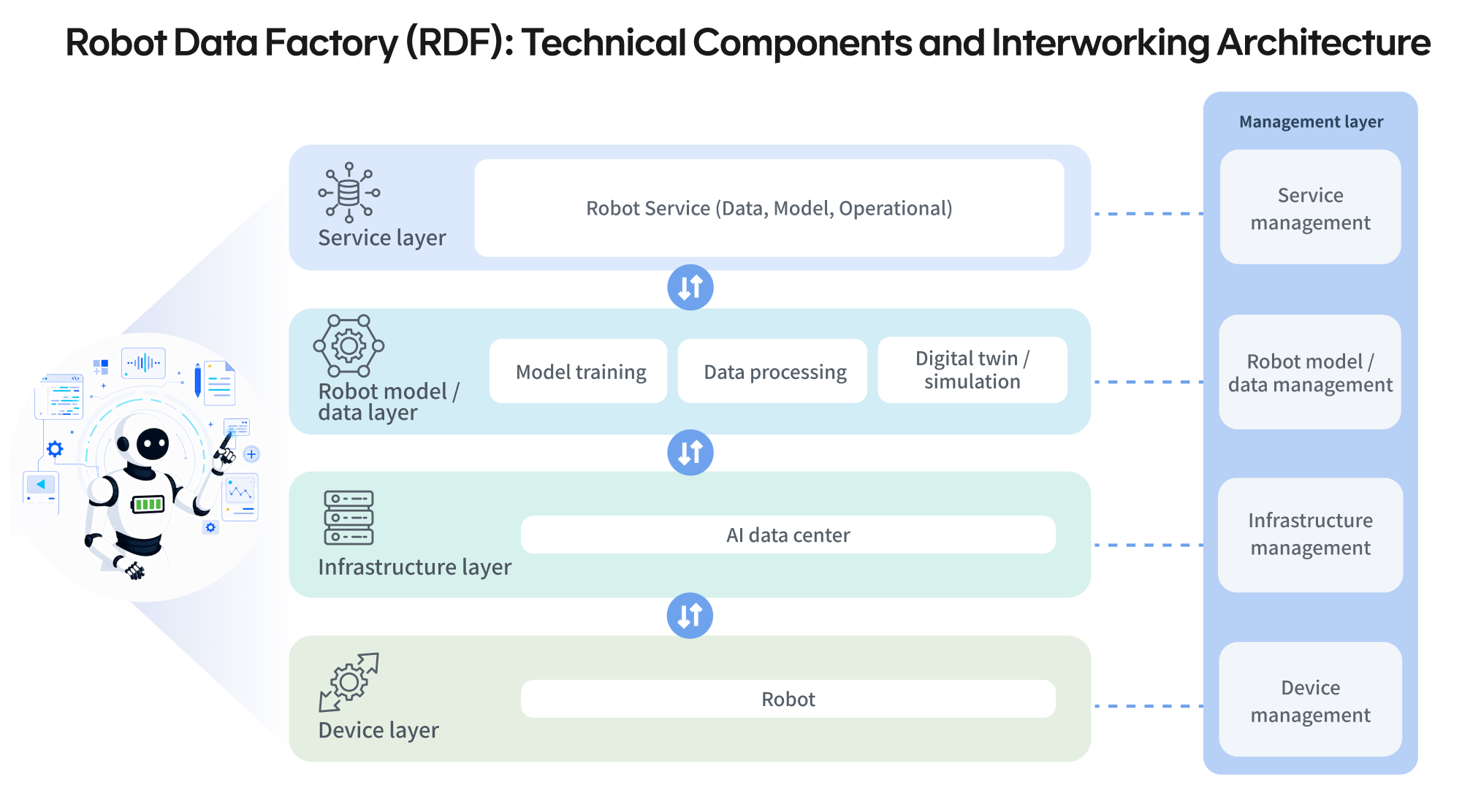
The adopted work item, “Signalling Requirements and Architecture for Robot Data Factory (RDF),” is SKT’s proposal to systematically produce and utilize data required for AI training of intelligent robots such as humanoids.
ITU-T is the telecommunication standardization sector of the International Telecommunication Union (ITU), a specialized agency of the UN, and develops international standards in the information and communications field. ITU has around 1,000 institutions, companies, and research organizations from some 190 member countries participating.
Robot motion data is akin to “practice problems” used to train robot AI. For robots to become smarter, they need “many” “good problems.” However, the way this data is created and exchanged differs by robot model and onboard software, making it difficult to achieve compatibility between different systems.
With the recent growth of the robot industry, demand has been increasing for large-scale, high-quality motion data needed for robot AI to learn how to grasp and move objects and use tools. However, because institutions and companies have collected and managed data in different ways, it has been difficult to secure sufficient scale and consistent quality.
Accordingly, SKT proposed a new standardization work item to ITU-T Study Group 11 (SG11) to define the roles of the key functions comprising RDF, its interworking structure, and data exchange methods. Following review and discussion by ITU-T members, the proposal was adopted as a new standardization work item at the July meeting
This work item divides the RDF structure into five layers: Service, Robot Model·Data, Infrastructure, Device, and Management.
SKT plans to establish the role of each layer and the interworking specifications between layers, enabling functions to be easily connected, replaced, and expanded across different robots and platforms.
SKT has been working to build and advance a digital twin platform for manufacturing AI. Building on this, the company is expanding into a robot learning platform that generates robot task data for use in AI training. SKT explained that the adoption of this work item was made possible by the digital twin, AI, and data capabilities it has accumulated over time.
Through this standardization work item, SKT plans to strengthen the utility of its digital twin-based robot learning platform, which is being prepared for launch in the second half of the year. Furthermore, building on this international standardization discussion, SKT aims to expand cooperation with domestic and international robotics and AI companies and research institutions, contributing to the revitalization of the robot data ecosystem.
“With the adoption of this new standardization work item, SKT has established a foundation for leading international standards discussions, leveraging the digital twin and AI capabilities it has accumulated in the Physical AI field,” said Choi Dong-hee, Head of AI Strategy Planning Office at SKT. “Going forward, building on our technological competitiveness spanning robot learning platforms and AI models, we will continue to spearhead international standardization in robotics.”