New Delhi, Nov 25: India’s biotechnology sector is poised for a major expansion, with the country’s bio-economy projected to reach $300 billion by 2030. Union Minister of State for Science and Technology Dr. Jitendra Singh has called on industry leaders, startups and investors to step up participation in genomics, multi-omics and advanced biotechnology to turn scientific progress into economic opportunities.
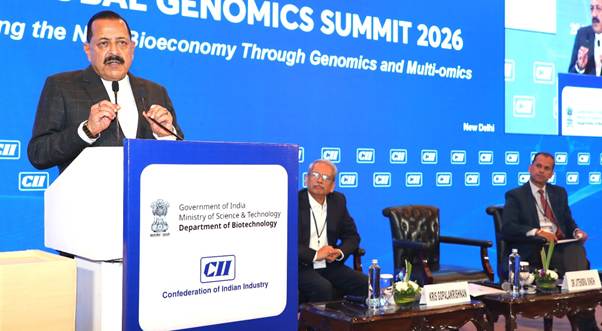
Addressing the CII Global Genomics Summit 2026 in New Delhi, the Minister said India’s biotechnology ecosystem had undergone a significant transformation over the past decade. The number of biotech startups has grown from around 50–60 in 2014 to nearly 11,000 today, while the bio-economy has expanded from approximately $10 billion to nearly $195 billion.
The summit, themed ‘Powering the Next Bioeconomy Through Genomics and Multi-omics’, brought together industry representatives and other stakeholders to explore ways of connecting scientific research with healthcare solutions, commercial applications and national development.
Biotechnology emerges as a strategic growth engine
Drawing a comparison with the role of information technology in an earlier phase of industrial transformation, Singh said biotechnology was now emerging as a strategic platform that would shape healthcare, agriculture and global economic competitiveness.
He cautioned that businesses would need to adapt to the changing technological landscape, warning that companies failing to embrace emerging technologies could risk losing relevance.
According to the Minister, the convergence of DNA sequencing, computational biology, artificial intelligence and advanced omics technologies—including metabolomics, transcriptomics and proteomics—is opening new possibilities in understanding complex diseases.
These tools can help develop more personalised treatment approaches by recognising that patients with the same disease may respond differently to medicines and therapies.
India’s genetic diversity offers research advantage
Singh highlighted India’s vast genetic diversity as a valuable resource for genomic research and innovation. The country’s diverse population groups and wide range of health conditions, he said, offer opportunities to generate scientific data and develop solutions with relevance beyond national boundaries.
Referring to the Genome India Project, the Minister said whole-genome sequencing of 10,000 individuals representing 80 population groups had been completed, creating an important foundation for future research.
He urged industry stakeholders to collaborate with government-led initiatives and convert this scientific resource into practical applications, new products and commercial opportunities.
Beyond healthcare: Opportunities in agriculture and livestock
The Minister also stressed that the benefits of genomics and advanced biotechnology extend well beyond human healthcare.
In agriculture, these technologies can support the development of crops with improved productivity, nutritional value and resistance to pests and diseases. They can also contribute to climate-resilient farming.
In the livestock sector, genomic applications offer scope for better breeding practices and stronger disease surveillance. Singh said these varied applications created opportunities for businesses to develop specialised solutions across multiple sectors.
BioE3 Policy aims to strengthen the ecosystem
Highlighting the government’s efforts to accelerate biotechnology-led growth, Singh referred to the BioE3 Policy—Biotechnology for Economy, Environment and Employment.
The policy, along with the development of bio-foundries and supporting infrastructure, is intended to strengthen research capabilities and help startups and industries move scientific discoveries towards commercially viable products.
He also pointed to India’s growing capabilities in advanced healthcare technologies as evidence of the sector’s progress. These include the country’s DNA vaccine for COVID-19, which was supplied to 30 countries, developments in HPV vaccines, research into haemophilia treatment and cost-effective CAR-T cell therapy for cancer at Tata Memorial Centre.
The Minister said such achievements reflected India’s increasing capacity to develop biotechnology products for domestic and international markets.
Private investment crucial to translating research into products
Calling for stronger industry participation, Singh urged private companies to increase research and development spending and establish partnerships with government institutions, research organisations and startups.
He identified the ₹1 lakh crore Research, Development and Innovation (RDI) Scheme as an important mechanism for encouraging private-sector investment in high-impact technologies.
He also encouraged businesses to use Corporate Social Responsibility (CSR) funding to support scientific research, particularly in areas such as cancer, diabetes and other major health challenges. Investment in research, he said, could generate benefits extending well beyond individual organisations.
Government seeks industry inputs on regulatory challenges
During his interaction with industry representatives, Singh identified the prevailing mindset towards emerging technologies as a major obstacle to India’s ambition of becoming a global genomics hub.
Responding to concerns about regulatory procedures for biotechnology products and advanced therapies, he said the government was working with the Ministry of Health and Family Welfare and the Indian Council of Medical Research (ICMR) to simplify processes and address overlapping regulatory requirements.
He invited industry representatives to submit specific concerns and practical recommendations, emphasising the need for better coordination among institutions.
CII urged to strengthen government-industry partnerships
Concluding his address, Singh called on the Confederation of Indian Industry (CII) to play a stronger role in connecting government institutions with industry, investors and research organisations.
He said the success of India’s scientific progress should be measured not only by the number of genomes sequenced or research papers published, but also by the lives improved, products developed and economic opportunities generated.
With a rapidly expanding startup base, growing research capabilities and a $300 billion bio-economy target for 2030, India is seeking to position biotechnology as a major pillar of its journey towards Atmanirbhar Bharat and Viksit Bharat 2047.