New Delhi, Nov 27: Union Commerce and Industry Minister Piyush Goyal has asserted that India’s economic growth remains strong, resilient and dependable despite mounting global uncertainties, calling for increased long-term investments and innovative financing mechanisms to support the country’s development ambitions.
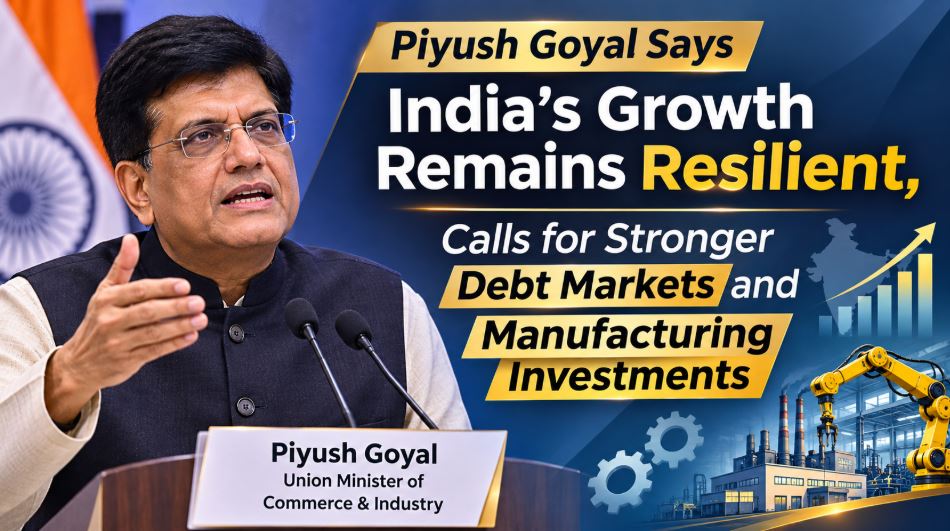
Representational Image
Addressing the India Debt Capital Market Summit 2026 on Friday, Goyal highlighted India’s economic performance, expanding export opportunities, infrastructure development and sustained policy reforms. He said the country had emerged as a trusted global economic partner and was well-positioned to maintain its growth momentum over the coming decades.
The Minister said India recorded economic growth of 7.8 per cent in the first quarter of the current financial year and expressed confidence that the momentum would continue in the second quarter. Gross fixed capital formation had grown by around 12 per cent, while exports reached USD 570 billion in the first seven months of the year.
He also pointed to credit growth of nearly 19 per cent as an encouraging sign of economic activity and investment demand. According to Goyal, India was progressing towards its ambitious USD 1 trillion export target, while October witnessed record monthly exports of USD 90 billion.
India Stands Firm Amid Global Economic Challenges
Highlighting the country’s ability to withstand international disruptions, Goyal said India’s economic performance remained encouraging despite geopolitical conflicts, volatile oil prices, uncertainty over global tariffs, disruptions to shipping routes and challenges affecting international air travel.
He said India’s growing foreign exchange reserves, strong remittance inflows and foreign direct investment had strengthened its capacity to absorb external shocks compared with two decades ago.
With a GDP of approximately USD 4 trillion and purchasing power parity-based economic output estimated at USD 18-19 trillion, India has become one of the world’s largest economies, he noted.
The Minister also underlined the country’s relatively low national debt levels and manageable external debt exposure, describing them as important foundations of long-term economic stability. He stressed that India had consistently honoured its international financial commitments, including during the COVID-19 pandemic.
Goyal further observed that domestic institutional and retail investors had played an important role in maintaining market stability during periods when foreign investors withdrew funds.
Reforms and Trade Agreements to Expand Market Access
The Minister attributed India’s economic transformation to 12 years of sustained reforms and policy initiatives rather than temporary favourable circumstances.
He said the Government’s long-term vision was aligned with the goal of building a developed India by 2047 and transforming the country into a USD 30 trillion economy over the coming decades.
Simplification of the Goods and Services Tax (GST), reduction in tax rates and improvements in the ease of doing business were among the measures supporting consumption and investment. He noted that GST collections reached a record high in October.
Goyal also highlighted India’s expanding network of free trade agreements (FTAs), which he said was opening up substantial opportunities for domestic businesses.
According to the Minister, India’s existing nine trade agreements covering 38 developed countries, finalised over the past four-and-a-half to five years, have significantly expanded its preferential market access. Including earlier agreements, India now has access to markets representing approximately USD 70 trillion in combined GDP.
The country is negotiating another eight to nine trade agreements, which could expand preferential market access to around USD 85 trillion out of the estimated USD 115-120 trillion global economy.
He said the India-European Union free trade agreement was expected to be signed later this year and become operational by March or April 2027. Discussions on the proposed India-US trade agreement were also progressing towards finalisation, he added.
Manufacturing and Exports Key to India’s Global Ambitions
Calling for a stronger manufacturing ecosystem, Goyal urged Indian businesses to increase investments, improve product quality and enhance domestic value addition to establish India as a globally competitive manufacturing destination.
He stressed that the country’s export ambitions would require greater manufacturing capacity, a skilled workforce and stronger participation in emerging technologies such as artificial intelligence, machine learning and quantum computing.
The Minister said expanding infrastructure, rising domestic consumption and improved access to international markets would create significant opportunities for manufacturers, agricultural exporters, seafood businesses and service providers.
He also pointed to the scale of India’s infrastructure requirements, observing that the country would need to construct more buildings over the next 30 years than the entire existing stock of residential and commercial buildings.
Goyal Pushes for Innovative Financing and Stronger Bond Markets
Emphasising the growing importance of debt capital markets, Goyal said India’s financing ecosystem must evolve to meet the requirements of a rapidly expanding economy.
He identified semiconductor manufacturing facilities, electricity transmission networks, data centres and the upcoming Vadhavan Port near Mumbai as major infrastructure projects that would generate substantial demand for long-term financing.
He said traditional financing channels alone would not be sufficient to meet the scale and diversity of investment opportunities emerging over the next two to three decades. The country would need faster financing mechanisms, innovative debt instruments and greater participation from private capital.
Goyal also highlighted India’s inclusion in global bond indices as an important development that could strengthen the country’s debt market and attract international investors.
He said bond and credit markets were fundamentally built on trust, making transparency, reliability and the credibility of borrowers essential for their development.
Five Priorities for Strengthening India’s Debt Capital Market
The Minister outlined five major priorities for the country’s debt capital market ecosystem.
First, he urged large corporations, public sector undertakings and infrastructure developers to make bond markets a preferred source of funding for capital expenditure, particularly for projects requiring long investment and repayment periods.
Second, he called on insurance companies, pension funds, provident funds and mutual funds to increase their participation in long-term debt markets. These institutions, he said, could provide patient capital and should consider opportunities beyond AAA-rated securities to support a broader credit ecosystem.
Third, Goyal stressed the need to improve bond market liquidity and make transactions simpler and faster, enabling bonds to be traded almost as conveniently as shares in the equity market.
Fourth, he encouraged exporters and financial institutions to convert the opportunities created by India’s trade agreements into concrete investment decisions, expand production capacity and build the infrastructure needed to serve international markets.
Fifth, he invited suggestions from industry participants and financial stakeholders, assuring them that the Government remained open to further reforms to improve the country’s financing ecosystem.
Focus on Inclusive Growth and Viksit Bharat 2047
Goyal said India’s development ambitions were not limited to economic expansion but also involved improving the quality of life of its citizens.
He highlighted initiatives in healthcare, education, housing, electricity, roads, digital connectivity and rural drinking water supply. Referring to the Jal Jeevan Mission, he said the Government was working to ensure access to tap water for households across villages.
He also cited the achievement of bringing approximately 50 crore people out of poverty over the past 12 years, describing the expansion of the middle-income population as an important source of future consumption and market growth.
Concluding his address, the Minister said India’s next phase of development would depend on stronger cooperation between the Government, private businesses, investors and financial institutions.
He reiterated that sustained reforms, export expansion, manufacturing investments and a deeper debt capital market would be crucial to achieving India’s ambition of becoming a developed nation by 2047.