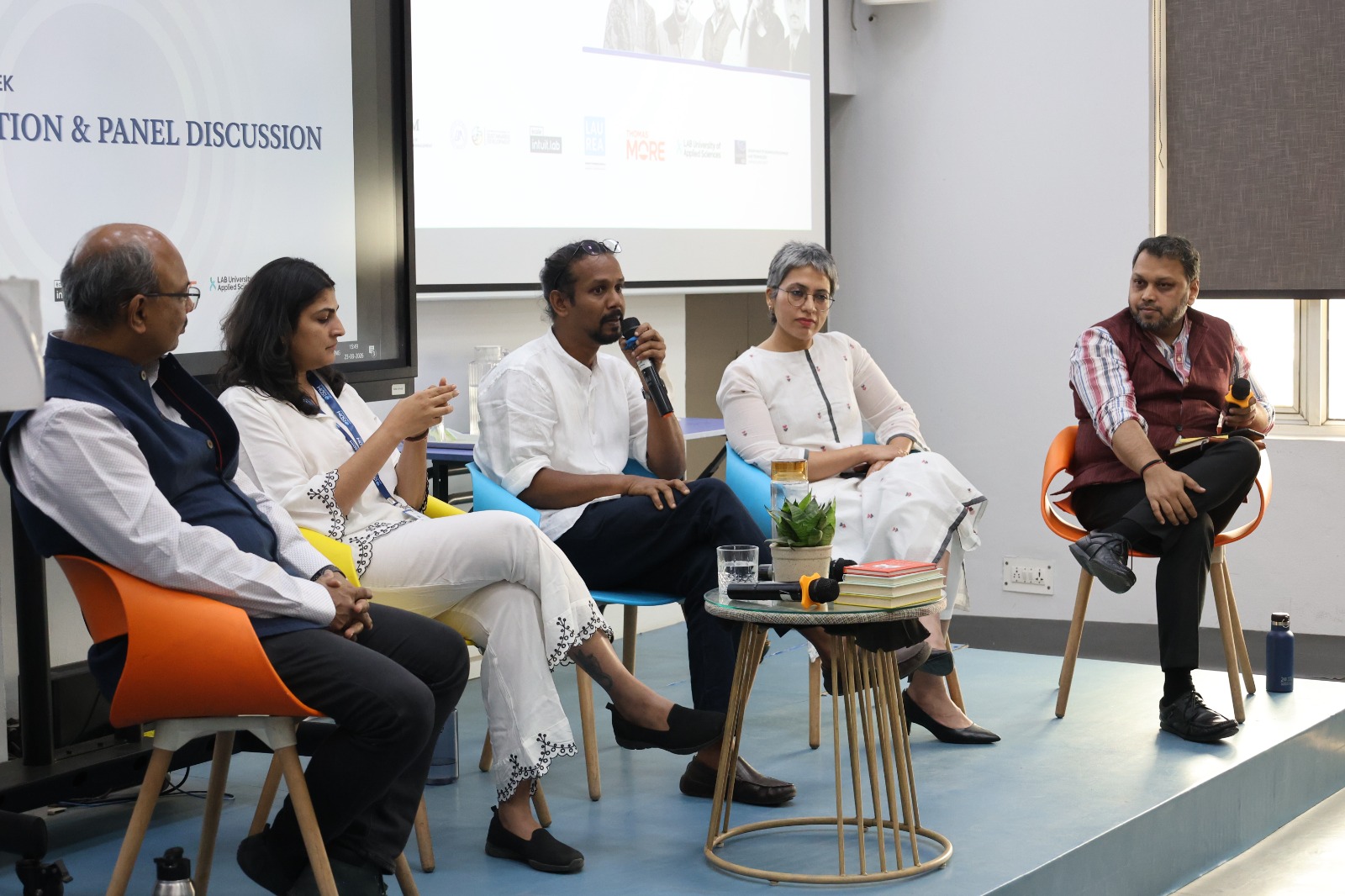
Panel discussion held under the Co-LIFE initiative brings together sector leaders to share on-ground realities of impact-focused work
Noida, Mar 26: The Indian School of Development Management (ISDM) hosted a panel discussion on 23 March 2026 at its Noida campus, bringing together practitioners working at the intersection of social change, sustainability, and entrepreneurship to examine what enduring impact actually requires.
Titled “Impact that Endures: Experiments in Sustainable Change,” the panel included Mani V G S (Karo Sambhav), Nidhi Batra (Sehreeti), Khushboo Gandhi (Go Do Good), and Rajesh N. Singh Meher (ComMutiny – The Youth Collective), and was moderated by Sulab Kumar, Lead – Operations and Strategy, Global Knowledge Hub, ISDM.
Rethinking impact from the ground up
Speakers drew on defining moments from their own work — instances that challenged their early assumptions about impact means and how it translates. From working with communities to navigating complex systems, speakers highlighted that impact is rarely linear. Instead, it evolves through constant learning, adaptation, and engagement with real-world constraints. The consensus: it is rarely linear, and almost never what it looked like on paper.
Sustaining impact: Choices, trade-offs, and realities
Panellists also discussed what it takes to sustain impact at an organisational level. Balancing scale with depth, managing financial sustainability alongside social goals, and navigating uncertainty and long-term commitment were recurring themes. Rather than presenting ideal models, speakers surfaced the tensions and trade-offs that shape real-world work in the sector.
Looking ahead: What future practitioners need
To close, speakers shared reflections for students and emerging professionals entering the sector. Key themes that surfaced during this discussion included the need for systems thinking and long-term orientation, the importance of staying grounded in community realities, and the ability to work through ambiguity and complexity.
Sharing insights on how her understanding of impact has evolved over the years, Nidhi Batra, Founder, Sehreeti Developmental Practices Foundation said, ‘The idea of planning for impact has shifted for me over the years. Now, I go back to the community for that knowledge. You may come up with great ideas, but reality is very different out there. You need to be in those settlements, in the community, to understand and achieve development.’
Creating spaces for dialogue and learning
The panel was part of a week of activities at ISDM that brought together students, practitioners, and academic partners to engage the growing need for entrepreneurial approaches that address social inequality, environmental sustainability, inclusive growth and long-term economic resilience.These engagements are designed to create opportunities for students to learn directly from practitioners and live projects designed to address real-world challenges.
Speaking on the significance of cross-border collaboration in the current global climate, Ravi Sreedharan, Founder, Indian School of Development Management, said ‘Such conversations and spaces as created by CoLIFE are critical because it gives us an opportunity for the Global South and the Global North to interact and learn from each other, especially in a world that is fractured by wars and national jingoism. CoLIFE, I believe, captures the much-needed spirit of collaboration, respecting and learning from diversity.’
