The streaming experience has changed dramatically. A few years ago, having a large content library was enough to attract viewers. Today, almost every major OTT platform offers thousands of films, shows and other programmes, making the bigger challenge helping people find something they actually want to watch.
This is where artificial intelligence is becoming an important part of the streaming business.
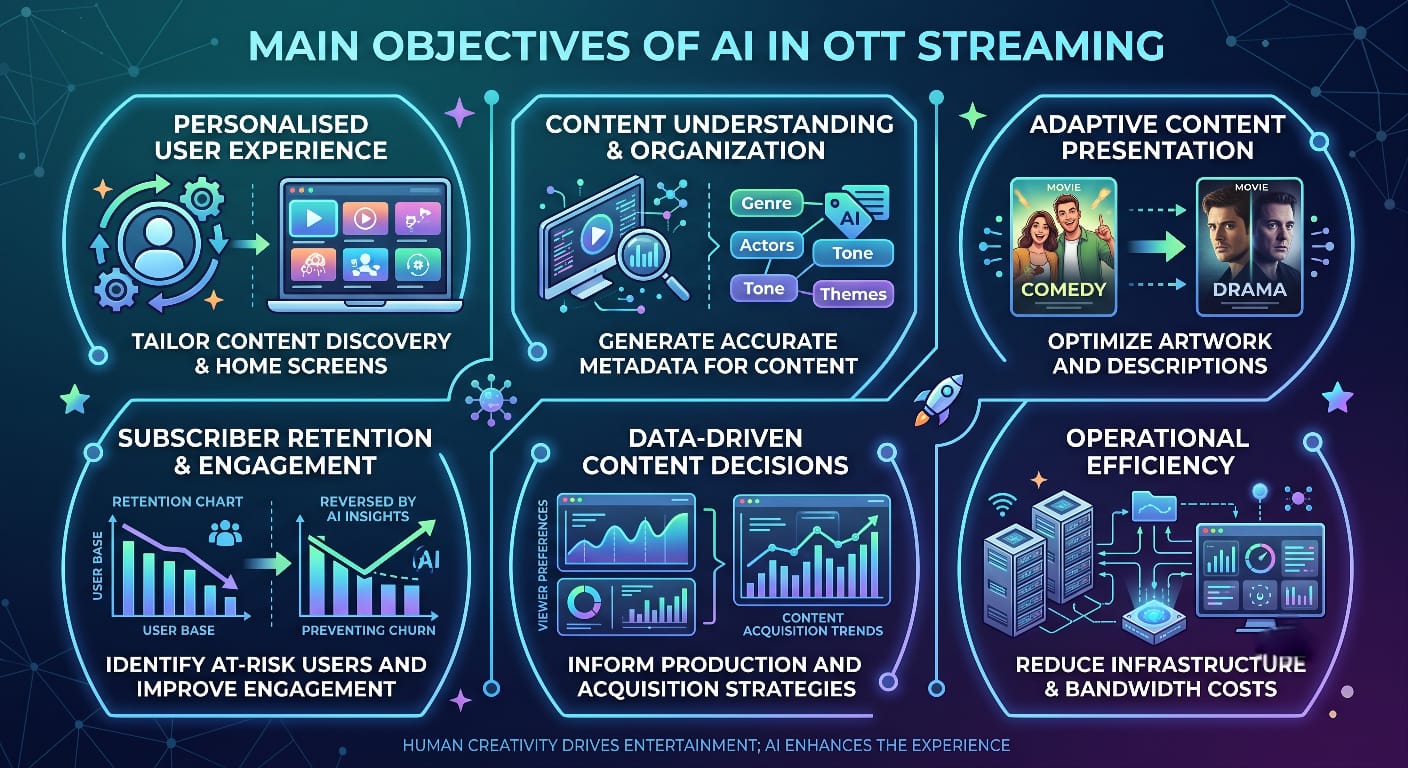
AI is moving beyond simple recommendation lists and helping platforms understand viewing behaviour, organise content, personalise the user experience, improve advertising and make better business decisions. For viewers, the change can mean less time searching and more relevant choices. For streaming companies, it can mean stronger engagement, better retention and more efficient operations.
The home screen is becoming more personal
The first few seconds after opening an OTT app can influence what a viewer watches. Instead of showing exactly the same home screen to every subscriber, AI allows platforms to tailor the experience according to individual viewing patterns.
The system can analyse signals such as the type of content a person watches, how frequently they watch, which titles they skip, what they search for and how long they spend viewing particular programmes.
Over time, these signals can help build a clearer picture of a viewer’s interests.
Someone who regularly watches crime series may see more thrillers and investigative dramas, while another viewer who prefers family entertainment may see a completely different selection.
The aim is not simply to offer more recommendations, but to make those recommendations more useful.
Recommendations are becoming more sophisticated
Traditional recommendation systems often depended heavily on similarities between viewers. If people who watched one programme also watched another, the second programme could be recommended to the first group.
AI-powered systems can go further by considering the characteristics of the content itself along with individual viewing behaviour.
Genre, language, actors, themes, tone and other characteristics can be combined with behavioural information to identify less obvious connections.
This can also help smaller or older titles find audiences instead of allowing only the most popular programmes to dominate the home screen.
For viewers, that can create a better chance of discovering content that matches their interests but may not have been obvious from a conventional recommendation system.
Even the way a show is presented can change
AI-driven personalisation can influence more than the order of programmes.
The artwork, descriptions and promotional material displayed for a title can also be adapted to different audiences. A viewer interested in comedy may respond to an image highlighting the humorous side of a programme, while someone who prefers serious dramas may be more interested in its emotional or dramatic elements.
These small changes can have a practical effect: they can make a programme more noticeable and potentially encourage a viewer to give it a chance.
AI is helping platforms understand their content
Large streaming libraries contain enormous amounts of video and audio material. Organising this information manually can be difficult and expensive.
AI can assist by analysing content and generating metadata related to genres, people, locations, objects, themes and other characteristics.
Better metadata can make content easier to search and can also provide recommendation systems with more information to work with.
AI can also support technical processes such as video enhancement and quality optimisation, helping platforms manage large and increasingly diverse content libraries.
Data is influencing content decisions
Producing a major series or film involves substantial investment, and there is no guaranteed formula for creating a hit.
AI cannot predict audience behaviour with certainty, but it can help content teams understand existing viewing patterns.
By studying what audiences watch, when they watch it and which types of stories keep them engaged, platforms can gain additional insights when evaluating content acquisitions and future productions.
This does not replace human creativity. Instead, data can give content teams another tool when making decisions in an industry where audience preferences can change quickly.
Keeping subscribers engaged is a major priority
The streaming industry faces another challenge beyond attracting new customers: keeping existing subscribers.
When viewers stop finding content that interests them, their engagement can decline. AI can identify changes in viewing behaviour that may indicate that a user is becoming less active.
Platforms can use these insights to improve recommendations and present content that is more relevant to the viewer.
The broader objective is to keep the service useful. If viewers consistently find something worth watching, they are more likely to see value in their subscription.
Advertising is also becoming data-driven
The expansion of advertising-supported streaming has created another area where AI can play an important role.
Platforms can use data analysis to understand different audience groups and help advertisers reach relevant viewers, while operating within privacy rules and user-consent requirements.
More precise audience segmentation can make advertising more useful for brands and potentially improve the commercial value of streaming platforms.
For viewers, better targeting could also mean fewer irrelevant advertisements.
AI can make streaming operations more efficient
Behind the screen, OTT platforms have to manage huge amounts of data and traffic.
Millions of people may be watching content at the same time, placing significant demands on networks and cloud infrastructure. AI can help platforms forecast traffic, monitor performance, optimise content delivery and identify potential technical problems.
It can also support more efficient video compression and data management.
For large streaming businesses, these improvements matter because even small reductions in infrastructure and bandwidth costs can become significant when multiplied across millions of users.
The financial impact goes beyond subscriptions
The business value of AI in OTT is not limited to increasing viewing time.
A more personalised platform can potentially improve several parts of the business at once — from content discovery and subscriber retention to advertising and operational efficiency.
Better audience insights can also help platforms understand where they are getting value from their content investments and where changes may be required.
This creates a connection between technology and business strategy that was less visible in the early years of streaming.
Human creativity still drives entertainment
Despite the growing role of AI, technology cannot replace the human side of entertainment.
Algorithms can identify patterns, but they cannot guarantee that audiences will connect with a particular story. Unexpected hits can emerge from programmes that do not fit historical viewing trends, while expensive productions can sometimes fail to find an audience.
Storytelling, creativity, cultural understanding and human judgement therefore remain central to the OTT industry.
The strongest platforms are likely to use AI as a decision-support tool rather than treating it as a replacement for creative thinking.
The next phase of streaming
The future of OTT is likely to be defined by increasingly personalised and responsive platforms.
AI could make it easier for services to understand changing viewer preferences, improve discovery, tailor the presentation of content and respond more quickly to shifts in audience behaviour.
For consumers, the biggest benefit may be a simpler viewing experience in which relevant content is easier to find.
For businesses, the opportunity is much broader: stronger engagement, improved customer retention, smarter content decisions, more effective advertising and better control of operating costs.
As competition intensifies, the winning advantage may not belong to the platform with the biggest content library. It may belong to the one that understands its audience best and uses technology to turn that understanding into a better viewing experience.