Goa, Nov 24: The story of filmmaker Awtar Kaul is one of remarkable creative promise cut short. Though he made only one feature film, the 1974 classic 27 Down, his work continues to occupy a significant place in discussions of Indian cinema. A new book, Awtar Kaul: The (In)Complete Story, seeks to bring his life and artistic contribution to the attention of a wider audience.
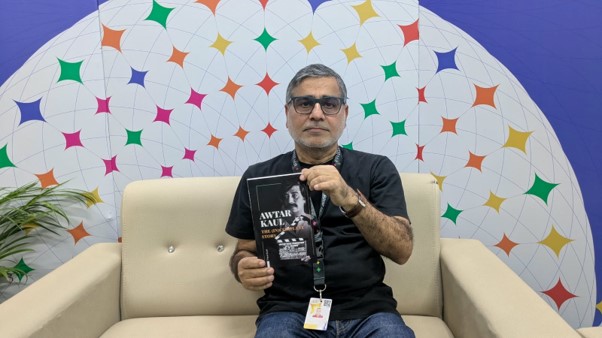
The book, authored by Vinod Kaul and published by the Publications Division, was released on November 21 during the 57th International Film Festival of India (IFFI) in Goa. It draws on letters, photographs, personal recollections and conversations to piece together the life and creative journey of the filmmaker.
At an interaction held at the festival on November 23, Vinod Kaul spoke about the personal memories and research that led him to document his uncle’s life.
A Family Search That Became a Cinematic Quest
The project did not begin as an attempt to write a book on an overlooked filmmaker. It started with a desire to know more about an uncle who died when Vinod Kaul was still in Class Two.
As he grew older, he began gathering photographs, letters and documents connected with Awtar Kaul. What began as an effort to preserve family memories gradually developed into a deeper investigation of the filmmaker’s life and work.
Vinod Kaul said his growing appreciation of 27 Down made him question why a filmmaker responsible for such a distinctive work remained relatively unfamiliar to a wider audience. That question eventually became the driving force behind the book.
His aim, he explained, was to introduce Awtar Kaul’s story to a new generation of viewers, readers and aspiring filmmakers.
Why the Story Is ‘(In)Complete’
The title Awtar Kaul: The (In)Complete Story reflects the unusual nature of the filmmaker’s legacy.
According to the author, very little had been documented about Awtar Kaul and his contribution to cinema. Bringing together scattered records and personal accounts has helped create a fuller picture of his life.
Yet the story remains incomplete in another sense. Awtar Kaul had a short married life and made only one feature film before his creative journey came to an end. Vinod Kaul reflected that, had his uncle lived longer, he might have gone on to make many more films.
The research also brought unexpected personal discoveries. One particularly difficult moment came when he learnt that his aunt, Ann Kaul, who was from the United States, had also passed away, a fact the family had not known. He described the discovery as a shock, underscoring how the search for historical details also reopened emotional chapters in the family’s past.
A Filmmaker Who Chose His Own Creative Path
The interaction also explored what contemporary filmmakers could learn from Awtar Kaul’s approach to cinema.
Vinod Kaul recalled that his uncle chose to make an art film at a time when mainstream Hindi cinema was finding popular success through films such as Zanjeer, Bobby and Yaadon Ki Baaraat.
Rather than follow prevailing commercial trends, Awtar Kaul pursued his own creative interests. Vinod Kaul urged young filmmakers to study 27 Down closely, particularly its storytelling, cinematic craft, message and filmmaking style.
The film, he suggested, offers an opportunity to understand the artistic choices of a director who followed a distinctive path despite the popularity of mainstream cinema.
Cinema, Literature and the Importance of Documentation
Reflecting on the relationship between cinema and literature, Vinod Kaul noted that the two forms have long influenced one another. Films have frequently drawn from novels, short stories and other literary works, creating a continuing exchange between written and visual storytelling.
He appreciated the Publications Division for supporting publications that explore this relationship and help bring important cinematic histories to readers. He also thanked the organisation for providing a platform to take Awtar Kaul’s story beyond the family.
Keeping an Unfinished Legacy Alive
More than a biography, Awtar Kaul: The (In)Complete Story represents an attempt to recover a filmmaker’s place in public memory through personal archives and historical research.
Its journey from a nephew’s curiosity to a published account also highlights the importance of documenting artists whose careers may have been brief but whose work continues to matter.
At IFFI 2026, the book has brought renewed attention to Awtar Kaul and 27 Down, inviting a new generation to revisit a distinctive chapter of Indian cinema and consider the creative possibilities left unexplored when a filmmaker’s journey ends too soon.