Moscow / New Delhi, Aug 31: Every year in the village of Kala Pipal, Madhya Pradesh, Ram Dongre watched his father make gods. Not metaphorically, literally. Clay, water, the pressure of his father’s thumbs, and a goddess would take shape: figures from the Puranic tradition that the tribal communities of Madhya Pradesh had been making in terracotta and dokra metal for centuries.
The figurines would be painted, dressed, worshipped through the festival season, and then immersed in a river and surrendered to the current. Dissolved. Gone.
Dongre grew up understanding something about art that no school teaches: that the sacred does not require permanence. That a god made by hand and returned to the earth has not failed. It has completed its purpose. He has been making work from that understanding ever since.
Dongre named by Forbes as one of seven artists to watch at the 2025 London Art Fair, will present new work at the 14th Cosmoscow International Contemporary Art Fair in Moscow, this month. Represented by Art Incept, he brings to Russia’s most prestigious contemporary art fair a practice rooted in some of the oldest living visual traditions on earth.
A Living Language, Not a Lost One
Dongre did not come to this heritage through scholarship. He studied painting at Khairagharh but what he brought there was already formed: a visual world absorbed from childhood, now given formal means. Puranic iconography, the terracotta and dokra traditions of Madhya Pradesh‘s tribal communities, the fresco aesthetics of Ajanta and the thirty-thousand-year-old rock paintings of Bhimbetka. Not subjects to depict. A language to speak.
He places these figures inside what he calls a state of magical realism: the imagined existing within the real, the sacred pressing against the everyday, without contradiction. His paintings are not recreations, they are the continuation of a conversation that has never stopped.
The Artist Who Scrapes His Own Paintings
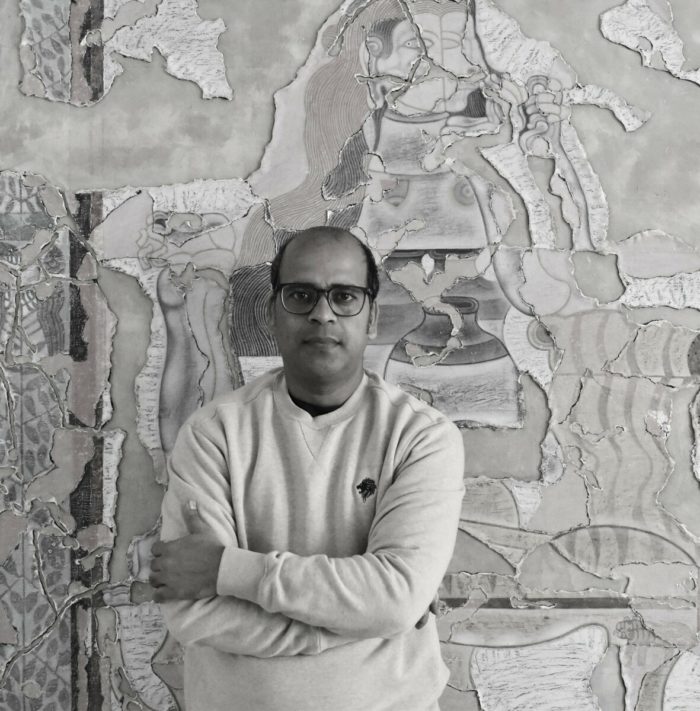
What distinguishes Dongre‘s practice most radically is his technique of deliberate erasure. He builds up paintings in layers – vivid, populated, mythologically dense – and then scrapes them back, layer by layer, with his own hands, until what remains is not a scene but a fragment. A gesture. A ghost.
The series is named Shesh Awshesh – Hindi for remains and residue, or more precisely, what is left. It is a meditation on how memory works: childhood does not preserve whole narratives, but shards – a smell, a colour, a half-seen figure in a crowded festival. The scraped surface of his canvases mimics exactly what has happened to the great fresco traditions of Ajanta and Bhimbetka: centuries of monsoon and silence have done to those walls what Dongre does with his own hands. What survives is not less meaningful for being incomplete. It is, in a precise sense, more honest.
Ram also works brings to Moscow his new series the Katha of Kanta series large-scale oil paintings drawn from the Kantha quilting tradition, in which generations of women across central India have stitched worn clothing into new objects, embedding in every thread the memory of the lives those garments once carried. For Dongre, the Kantha quilt is not a craft. It is a philosophy: that what appears to be discarded can be reassembled into something that carries its entire history, visibly, on the surface.
Ancient Roots, Original Voice
What makes Dongre‘s work compelling to international audiences and to Cosmoscow‘s curators is its confidence. There is no translation happening in these paintings, no mediation between heritage and the present tense. The work reads as unmistakably contemporary and unmistakably Indian, not because those qualities are being balanced against each other, but because for Dongre they were never in tension. The deeper a practice is rooted, the further it can reach and the theme What Remains Beneath the Surface seems almost designed for what he is bringing.
Forbes, London, and the Road to Moscow
In January 2025, Forbes named Ram Dongre one of seven artists to watch at the London Art Fair, writing of a practice that “peels back layers of the past” and connects lost heritage to living contemporary life. He exhibited in the Platform section of the fair, curated by Virginia Damtsa. He is currently an artist-in-residence at the German Embassy in New Delhi. His works are held in the collections of Kumar Mangalam Birla and Boston Consulting Group.