Gandhinagar, Nov 21: A year after the four Labour Codes came into effect, the Centre and state governments have begun a fresh round of discussions on their implementation, with Union Labour Minister Mansukh Mandaviya calling for a balance between workers’ welfare and industrial expansion as India moves towards its 2047 development goals.
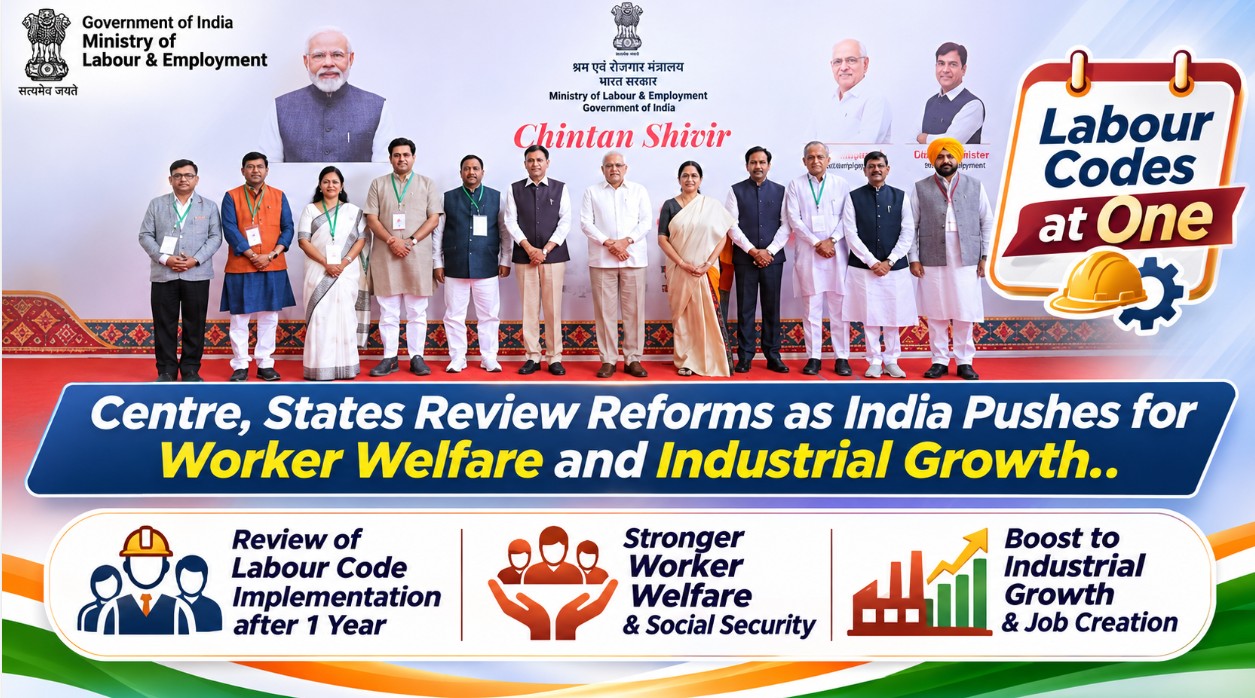
The two-day Chintan Shivir of Labour and Employment Ministers from states and Union Territories opened at Mahatma Mandir in Gandhinagar on Saturday. Organised by the Ministry of Labour and Employment on November 21–22, the meeting marks the first anniversary of the Labour Codes coming into force on November 21, 2025.
Gujarat Chief Minister Bhupendra Patel and Mandaviya jointly chaired the inaugural session. Union Minister of State for Labour and Employment Shobha Karandlaje, along with state ministers and senior officials, also attended.
Addressing the gathering, Mandaviya described workers’ welfare and industrial growth as the two essential drivers of national progress. He said India’s development would depend on strengthening industries while ensuring that workers receive adequate protection and social security.
Labour reforms linked to Viksit Bharat vision
Mandaviya described the implementation of the Labour Codes as a significant milestone in India’s journey towards becoming a developed nation by 2047.
He highlighted provisions relating to minimum wages, wider social security coverage and fixed-term employment, while pointing to the Codes’ objective of simplifying compliance requirements for businesses and supporting industrial growth.
The Minister also cited a substantial expansion in social security coverage, saying the number of people covered had increased from 25 crore in 2014 to 101 crore in 2026. He presented the rise as evidence of the government’s efforts to extend welfare protection to a wider section of the workforce.
Calling for a coordinated approach, Mandaviya urged states and other stakeholders to work together in the spirit of Team India for the welfare of the country’s seven crore workers.
He also stressed the importance of preparing India’s workforce for international opportunities, citing growing global demand for skilled Indian workers and the country’s demographic advantage. Discussions on overseas employment prospects for young people and cross-border labour mobility, he said, would be important areas of focus.
Gujarat CM stresses dignity and empowerment of workers
In his keynote address, Gujarat Chief Minister Bhupendra Patel said workers’ dignity, welfare and empowerment were central to the country’s nation-building efforts.
Referring to the changes brought about during the first year of Labour Code implementation, Patel said India was moving towards a stronger and more worker-focused labour ecosystem.
He described the Chintan Shivir as an opportunity for states and Union Territories to exchange successful practices, improve coordination and develop a common approach to labour welfare and industrial development.
Patel said the two priorities must advance together if India is to strengthen its position as a global economic power.
States to review implementation and social security reforms
Secretary of the Ministry of Labour and Employment Chandra Bhushan Kumar called for a shift in administrative approach to ensure that the Labour Codes are implemented effectively.
He urged state representatives to share their experiences, identify practical challenges and present successful initiatives that could be adapted by other states and Union Territories.
The first day’s programme includes four thematic plenary sessions covering the status and future course of Labour Code implementation, employment initiatives and Employees’ Provident Fund Organisation (EPFO) reforms, Employees’ State Insurance Corporation (ESIC) reforms, and social security for unorganised workers and labour statistics.
Parallel sessions for field officials are focusing on implementation strategies, engagement with micro, small and medium enterprises (MSMEs), field-level initiatives and trust-based electronic compliance systems.
The discussions are expected to help governments assess progress, exchange operational experience and identify areas requiring further attention as the Labour Codes enter their second year.
The broader objective, Mandaviya said, is to ensure that economic expansion and the protection of workers’ interests remain complementary priorities in India’s development journey.