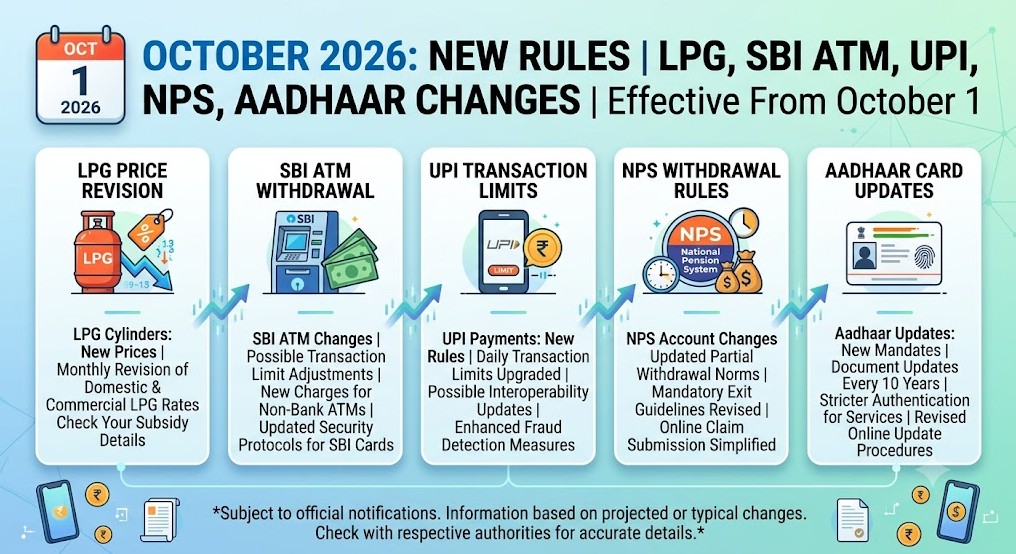
New Delhi, Oct. 1: Several financial, banking and documentation-related rules are set to change from October 2026, affecting LPG consumers, SBI Salary Package Account holders, NPS subscribers and people dealing with birth, death and Aadhaar records.
Representational Imge
While most of the changes take effect from October 1, the revised framework for certain UPI merchant payments will come into force from October 15.
Here are the key changes consumers should know:
LPG Subsidy: Aadhaar Biometric Authentication Required
Domestic LPG consumers seeking subsidised refills at the regulated retail selling price will need to complete Biometric Aadhaar Authentication (BAA) from October 1.
Consumers who have already completed the authentication will not need to repeat the process.
Those yet to complete it can reportedly do so during LPG delivery, at their distributor’s showroom or through the mobile applications of their respective oil marketing companies.
Consumers who do not complete the authentication can continue to receive LPG, but subsidised refills may not be available to them and cylinders will be supplied at the applicable market price, subject to local availability.
SBI ATM: Free Other-Bank Transactions Reduced
State Bank of India (SBI) is revising the free ATM transaction limit for Salary Package Account holders.
From October 1, the number of free monthly transactions at other banks’ ATMs and Automated Deposit-cum-Withdrawal Machines will be reduced from 10 to five.
The limit covers both financial and non-financial transactions. Once the free limit is exhausted, applicable charges will be levied.
The reported charges are Rs 23 plus GST for cash withdrawals and Rs 11 plus GST for non-financial transactions.
The revised limit applies specifically to SBI Salary Package Account holders using other banks’ ATMs and should not be interpreted as a change applicable to all SBI customers.
Bulk Fixed Deposits: New RBI Disclosure Norms
The Reserve Bank of India has introduced revised rules concerning bulk deposits from October 1.
For scheduled commercial banks, a bulk deposit generally refers to a single rupee term deposit of Rs 3 crore or more.
The new framework does not automatically change interest rates on ordinary retail fixed deposits. Instead, it strengthens disclosure requirements for large deposits.
Banks will have to publish applicable bulk-deposit interest rates on their websites at 10 am on every business day, with a 10-minute grace period for updating the information.
The RBI has also specified rules concerning uniformity of interest rates for similar bulk deposits accepted on the same day, subject to permitted differential-rate provisions.
UPI: MDR on Select Merchant Payments From October 15
A revised Merchant Discount Rate (MDR) framework for certain UPI merchant transactions will take effect from October 15.
Under the framework described in the source material, eligible merchant payments above Rs 2,000 can attract an MDR of up to 0.4%, subject to applicable categories and limits.
The charge is applicable on the merchant side and does not amount to a general fee for consumers making UPI payments.
Person-to-person UPI transfers are also outside this merchant MDR framework.
NPS: Revised Point-of-Presence Charges
The Pension Fund Regulatory and Development Authority (PFRDA) has revised the charge structure applicable to Point of Presence (PoP) channels for the National Pension System (NPS), NPS Vatsalya and NPS Lite.
The revised framework includes an onboarding charge of Rs 200 for accounts opened through the PoP channel, along with prescribed charges for specified onboarding and servicing activities.
Subscribers should check the applicable charges based on the channel through which they access NPS services.
Delayed Birth and Death Registrations to Face Stricter Process
The Registration of Births and Deaths (Amendment) Act, 2026 is set to introduce tighter requirements for delayed registrations from October 1.
For applications submitted more than one year after the event but within two years, an order from the District Magistrate, Sub-Divisional Magistrate or authorised Executive Magistrate will be required, along with prescribed verification and fees.
Where registration is delayed by more than two years, an order from a Judicial Magistrate of the First Class will be required following verification and payment of the prescribed fee.
Aadhaar: Check Child Biometric Update Rules
Parents of children who are due for mandatory biometric Aadhaar updates should also take note of the applicable fee rules from October 1.
The fee waiver for certain mandatory biometric updates for children aged 5 to 17 years is scheduled to end on September 30, 2026, according to the information provided.
Outside specified free-update categories, UIDAI’s fee schedule provides for charges for biometric updates. Parents should check the child’s age, eligibility and applicable category before visiting an Aadhaar centre.
What Changes First?
The changes beginning October 1 cover LPG subsidies, SBI ATM transactions, bulk-deposit disclosures, NPS services, delayed civil registrations and Aadhaar-related updates.
The UPI MDR change comes into effect later, from October 15, and concerns specified merchant transactions rather than ordinary person-to-person UPI transfers.
Consumers should check the specific terms applicable to their bank account, LPG connection, NPS channel or Aadhaar service before making a transaction or seeking a service.